
Triplet
2025.11.21Tourism Sites Go AI… Triplet Deploys Real-Time Spatial Intelligence at Naejangsan and Suncheonman
AI real-time spatial intelligence has been introduced at Naejangsan National Park and Suncheonman National Garden, enabling visitors to enjoy a more comfortable tourism environment.
 news/--ai...--_1772329917.790949.png
AI real-time spatial intelligence has been introduced at Naejangsan National Park and Suncheonman National Garden, crowded tourist destinations, enabling visitors to enjoy a more comfortable experience.
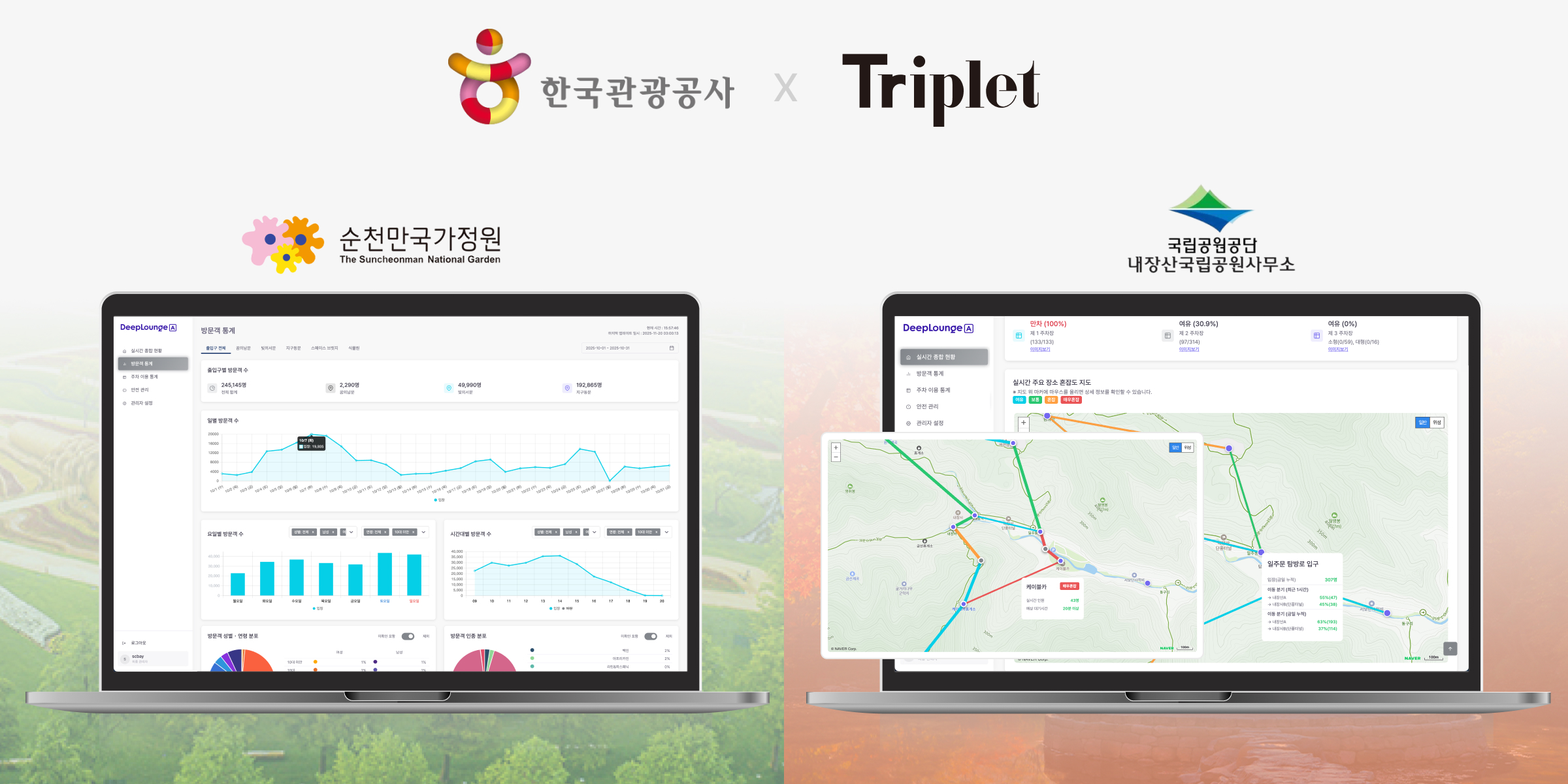
AI spatial intelligence company Triplet deployed real-time congestion, movement, and safety analysis technology at Naejangsan National Park and Suncheonman National Garden through the Korea Tourism Organization's '2025 Tourism AI Open Innovation (TRVL-X)' program.
This addresses common challenges faced by tourism site operators and local governments—congestion management, increased wait times, and uncertainty in safety response—through AI-based data analysis.
At Naejangsan National Park, bottlenecks have repeatedly occurred at access roads, trail junctions, the cable car area, and the autumn foliage tunnel during peak foliage season.
Through Triplet's system that analyzes existing CCTV feeds at up to 17 key points including main access roads, trail junctions, and popular foliage spots, operators can now capture high-resolution data on visitor entry/exit flow, sectional occupancy and movement patterns, domestic/international visitor composition changes, and timing differences between cable car and hiking usage.
With analysis results enabling early response, on-site management has become more sophisticated—including visitor dispersion guidance, hazard zone adjustments, and access control. Rather than temporary measures for fall foliage season, a foundation has been built for year-round data accumulation to support overall national park management strategies.
AI camera-based analysis has also been applied to key facilities at Suncheonman National Garden, including the ecological garden, lake garden, theme garden, and observation bridge, for real-time visitor counting, occupancy changes, congestion levels, and nighttime abnormal activity detection.
Parking lot congestion data integrated with map services helps visitors choose the most available parking spaces.
While tourism sites traditionally relied on CCTV monitoring and on-site patrols, responding only after congestion occurred, the AI deployment has improved response capability during understaffed hours and enabled preventive management of hazardous zones.
As data accumulates by season, day, and time, local governments can make more evidence-based policy decisions regarding parking expansion, signage improvements, trail rerouting, and event operations.
Triplet CEO Donghwa Shin said, "The purpose of AI spatial intelligence is to make operations smarter while preserving the natural landscape." He added, "Starting with this demonstration at Naejangsan and Suncheonman, we will develop a standardized operational model applicable to national parks, gardens, provincial parks, outdoor museums, and large-scale tourism sites nationwide."
Source: Digital Daily (https://www.ddaily.co.kr/page/view/2025112116201494136)
What does your space need to decide?
Data without interpretation disappears. Turn your spatial signals into operational answers — with Triplet.
Contact us